What happens
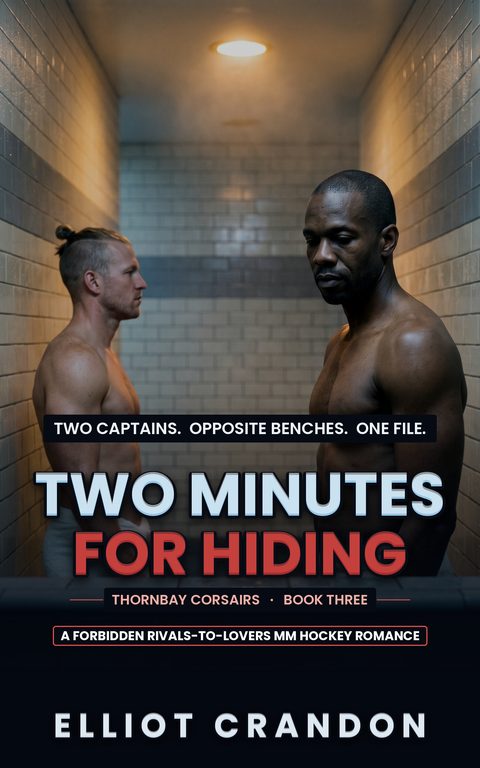
Sam Okonkwo has eleven Septembers in Thornbay, an alternate captain's letter, and a contract
that runs out on the thirtieth of June. He is thirty-six. He knows exactly what that means and
has stopped saying it out loud.
Rhys Prescott captains the club Thornbay has to get through. He has spent twenty-five years
arranging his life so that nobody gets behind him, and it has never once failed him. That is
the entire trouble with it.
What is between them is against the rules of the league they both work for. By February there
is a file with both their names on it.
Tropes
- Forbidden — the two men captain clubs on opposite sides of a playoff bracket
- Rivals to lovers, across the line — not two men competing for the same job, but two men
who are supposed to be trying to end each other's season
- Secret relationship, kept from both rooms and from the league office
- Age gap of three years, and an ending career on one side of it
- Touch-starved, and a man who has spent twenty-five years arranging his life so nobody gets
behind him
- Hurt/comfort, where the comfort is mostly somebody staying in the room
Heat level
Explicit. The sex is on the page and stated outright — nothing is cut away or implied.
Seven full scenes and several shorter ones, and none of them fade out.
It is more explicit than either book before it, and more physically specific: what a body does,
what it tastes like, what it will not do on command. That specificity is doing work. One of
these men has spent his life in a body that has been used against him, and the book is
interested in the difference between a body that is taken and a body that is given.
Consent is visible and active in every scene, including the group scene — asked for in
advance, refusable, and refused once, on the page, by the man you will not expect.
What you will not find is dirty talk. These two do not narrate. What they say to each other in
bed is short and practical.
What kind of book this is
Sports fiction with a love story at the center of it, told in close third person from both men
in turn — twenty-two chapters each. Its subject is what a man does with a childhood he has never
told anyone about, and what happens to him when somebody finds out by accident and stays anyway.
The commitments at the end are made with objects and dates rather than declarations: a deed, a
key under a brick, a contract, a month in the calendar.
This book does not cure anybody. The man carrying this history is still carrying it in the
last chapter. What changes is when he speaks, and what the other man does when he does.
What it promises
HEA, and no third-act breakup. Nobody walks out near the end to be won back. The series
continues past this book. This story does not — it finishes here, completely, with no
cliffhanger.
Read the opening
THORNBAY, CORSAIRS ARENA—THE SECOND OF SEPTEMBER
Sam Okonkwo
THE BUILDING SMELLED of sealant.
They do the concrete in July, when the ice is out and the place is a warehouse with a hole in the middle of it. By the first week of September it has gone down to a thin sweetness under the paint. You get six days of it. After that you stop noticing and you have the rest of the year for free.
Okonkwo came in the players’ door at ten past six with a coffee that had turned bitter on the drive.
He drank it standing, at the end of the corridor, out of the way of the door.
The corridor runs ninety feet from the lot to the room and nobody has touched it since the club moved in. Cinder block, painted the color of an envelope. A rubber runner down the middle with the tread worn off it in two lines, because men walk on their skates in a hallway they have been told for fifty years not to walk on their skates in.
The captains are on the left wall.
Forty-one of them.
He counted them. He counted them every year on the first morning, left to right, oldest at the far end, and the first ten are standing in a rink that came down before his father was born, because the club is older than the building.
The frames go brown and silver for a while. Then they go color. Then they go to the kind of photograph a club pays somebody for, with a light set behind the man’s shoulder and his gloves off.
Under each one there is a name and two years.
Sixteen of the forty-one were finished at thirty-six or before it. He had never gone looking for that. It had assembled itself out of ten Septembers and this one, the way a number does when you walk past it twice a day.
“You’re early,” Mercier said, behind him.
Roly Mercier came down the corridor with the cane out in front of him, putting it down and then arriving at it. He is seventy-one. He had the letter here for four seasons a long time ago, and the club gives him a pass, and he uses it on the first morning of camp and on nothing else, and nobody has ever asked him to explain that.
“You’re earlier,” Okonkwo said.
“I don’t sleep. What’s your excuse.”
“Traffic on Doray.”
“There’s no traffic on Doray at six in the morning.”
“There was one truck.”
Mercier stopped in front of the fourth frame from the door and tapped the glass twice with the cane, which is a thing the equipment manager has asked him not to do.
“Four hundred and six games,” he said. “Captain for eight months.”
“I know it.”
“So does nobody else.” He got himself turned around. “It’ll be forty-two when Wes is done.”
“That’s a while.”
“It’s always a while,” Mercier said, and went off toward the room, and did not look at any of the other forty.
An excerpt from the first chapter. The book is available on Amazon.
Where it sits in the series
Book three of the Thornbay Corsairs, and the one that goes furthest. It stands alone: a
different couple, a season that opens and closes inside these covers, and an ending that is
settled on the page. Read after books one and two, it pays off a room you already know.
 Elliot Crandon