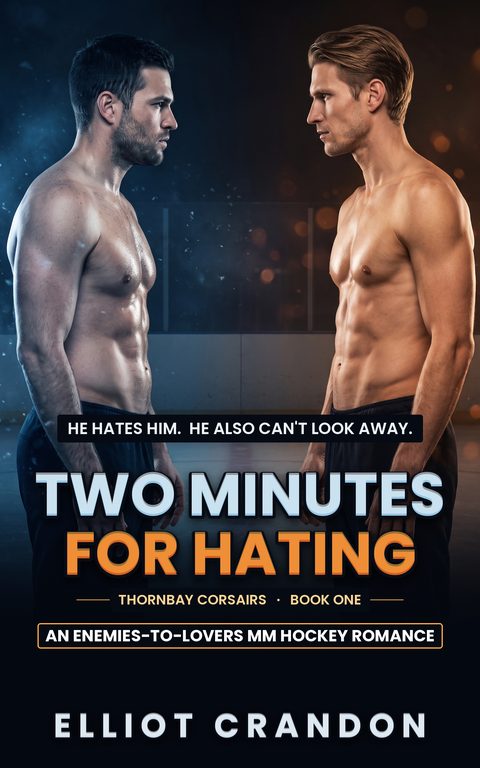
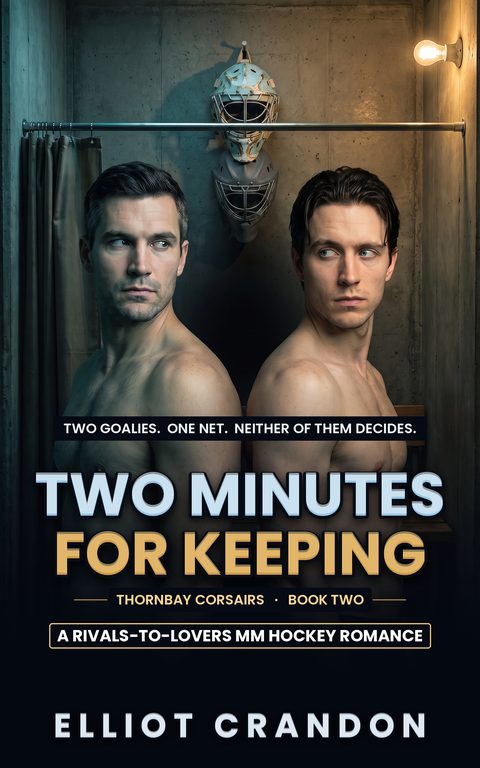
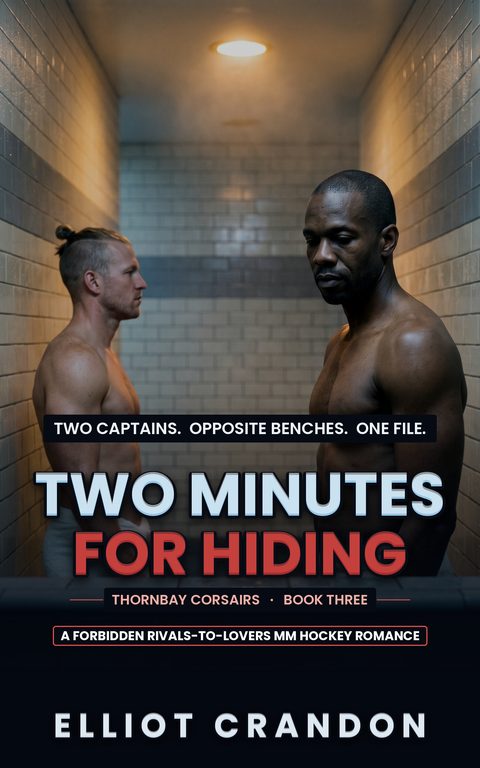
What happens
Dominic Fiore has been traded four times in seven years and keeps his life in eight boxes he
never opens. He has a new contract, a new city, and a locker room where nobody will ask him
about the hit.
Wes Kellow has worn the letter in Thornbay for four years and has never taken back a single
word of what he said on camera. Now the man he said it about is on his line.
They have twelve games on the road, one rooming list, and a coach who has told them to come
back a line or find out which one of them he keeps.
Tropes
- Enemies to lovers — they have never been together before, and the hostility is earned
- Rivals to teammates — they are put on the same line and have to make it work
- Forced proximity — a road-trip rooming list, a hotel room with two beds
- Slow burn — the first time anything happens is roughly halfway in
- Hurt/comfort
- A private relationship — neither man is out to the room, and the book takes that seriously
- Found family, of the kind a locker room actually makes
Heat level
Open door, but restrained. There are three explicit scenes. They are short, they are
written for what they reveal about the two men rather than for detail, and the book spends far
more time on silence, routine, and the things neither of them says.
If you came for high heat, this is not that book, and you should know it now rather than at
sixty percent.
About the rest of the series. The restraint above is a property of this book, not of the
series. Two Minutes for Keeping and Two Minutes for Hiding are explicit, and the explicit
parts are on the page. Each book says so on its own version of this page, so you can decide one
book at a time.
What it promises
HEA, no cheating, no cliffhanger. This book ends happily for both men, and each book in
this series does. Every book stands alone.
Read the opening
THORNBAY—EARLY SEPTEMBER
Dominic Fiore
THE PLANE LANDED at four oh nine. Nine minutes early.
Nobody met him at the bottom of the escalator, and that was correct. Clubs met players in June, when there were photographs to take. In September they sent an address. The message had come in that morning from the operations line and said the keys were with the building manager and to call if he needed anything, and he had read it twice on the descent and decided he did not need anything.
Two bags. The sticks were coming by freight on Wednesday.
The terminal smelled like floor cleaner laid over fryer oil. There were four cabs and no line.
“You’re him,” the driver said, with the trunk already open.
“I’m him.”
Outside the doors the wind came in off the water with a temperature in it, and he stood in it a second with his collar open, because it was forty degrees colder than the city he had left that morning and he wanted to know exactly how much colder before he put a coat on.
The driver looked at the mirror at the light by the second bridge, the way people look at a mirror when they are deciding whether to say the rest of it. He decided.
“Four years ago.”
“Yeah.”
“Huh,” the driver said, and then he talked about the bridge for fourteen minutes, how they had closed the westbound span in March and how nobody could tell you when it was opening, and Fiore said uh-huh in the right places and watched the yards go by on the left, long sheds with their roofs open to the sky and the gantries still standing over water nobody worked anymore.
He tipped twenty percent. He tipped twenty percent everywhere. A man who tips twenty percent everywhere never has to decide what a ride was worth.
The building was six floors of brick two streets up from the arena, and at the end of the street there was the water, gray and moving. Rent was six hundred less than the last place, and the last place had been a bad place.
The lease was nine months with an option, which was three months longer than the last one and five months longer than the one before that, and the woman at the desk said most tenants took the twelve because the twelve came with the parking, and he said nine was fine, and she said it was really no difference in price, and he said nine was fine.
She printed it. He signed it. She asked whether he wanted the second key on the ring or loose, and he said loose.
The place had a window that faced the water and a radiator that ticked. Two rooms. He had seen worse in the third city.
The movers wanted to know which boxes went where. He told them the wall. All of them, the wall, thanks.
Eight boxes. He had started with fourteen, seven years ago, and every move since had been a decision about which ones were worth the freight. The books went at the second move. The kitchen went at the third. What was left was clothes, a lamp he liked, four framed things he had never hung, and one box he could no longer identify from the outside and had stopped opening on principle.
The club had left a folder on the counter. Parking pass. Camp schedule, printed, with Thursday circled by somebody who circled things. A laminated card with four phone numbers on it, the last one marked “anything at all, any hour.” A jacket in a plastic sleeve with the size already right. Somebody had called his agent to ask.
The crest sat on the breast pocket, small, stitched heavy: a sail leaned over hard and a straight line under it for the horizon. Navy and brass. He had been looking at that sail across a faceoff dot since he was twenty-two years old, and he had hated it the way you hate a color, with no work involved.
An excerpt from the first chapter. The book is available on Amazon.
Where it sits in the series
This is book one of the Thornbay Corsairs — three books, three couples, one invented club in
an invented league. Every book stands alone and ends happily, and you can read them in any
order. Read in sequence, you watch a room fill up: the men who carry books two and three are
already on the ice here, with names and jobs of their own.
 Elliot Crandon